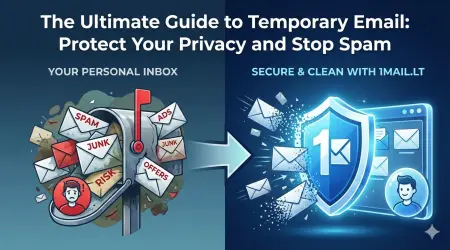

Temporary Email vs Regular Email: What Is the Difference?
If you have ever wondered whether a temporary email or a regular email is better for a specific situation, you are not alone. Both serve different purposes, and understanding the difference can help you stay safer and more organized online.
In this guide, we break down exactly how temporary emails and regular emails compare — and when to use each one.
What Is a Regular Email?
A regular email is a permanent email account provided by services like Gmail, Outlook, or Yahoo. You create it with your personal information, set a password, and use it for ongoing communication. It is tied to your identity and stores all your messages indefinitely.
What Is a Temporary Email?
A temporary email (also called a disposable or throwaway email) is a short-lived email address that requires no registration. Services like 1mail.lt generate an instant email address you can use right away. Once you are done, the address and all messages are automatically deleted.
Key Differences at a Glance
Registration: Regular email requires signup with personal details. Temporary email needs no registration at all.
Lifespan: Regular email is permanent and lasts as long as you maintain it. Temporary email expires automatically after a short period.
Privacy: Regular email is linked to your real identity. Temporary email is completely anonymous.
Storage: Regular email stores all messages permanently. Temporary email deletes everything when it expires.
Spam exposure: Regular email accumulates spam over time. Temporary email eliminates spam entirely since the address disappears.
Use case: Regular email is for ongoing personal and professional communication. Temporary email is for one-time signups, testing, and privacy-sensitive situations.
When to Use a Regular Email
Your regular email is essential for work and professional communication, banking and financial services, social media accounts you plan to keep, important subscriptions and services, and any account where you need password recovery access.
When to Use a Temporary Email
A temporary email from 1mail.lt is the better choice when you are signing up for a one-time download or free trial, accessing content behind an email registration wall, testing websites or apps as a developer, registering on forums you may only visit once, or any situation where you do not want to share your real email address.
Can You Use Both?
Absolutely — and you should. The smartest approach is to use your regular email for important, long-term accounts and a temporary email for everything else. This keeps your primary inbox clean, reduces spam, and protects your privacy.
Think of it like having a permanent home address and a P.O. box. You give your home address to trusted contacts and your P.O. box to everyone else.
Get Your Temporary Email Now
Ready to start protecting your privacy? Visit 1mail.lt and get a free temporary email address in seconds. No signup, no passwords, no hassle.